[11]competition
★ 2 hours · finished laterByte the Vibe
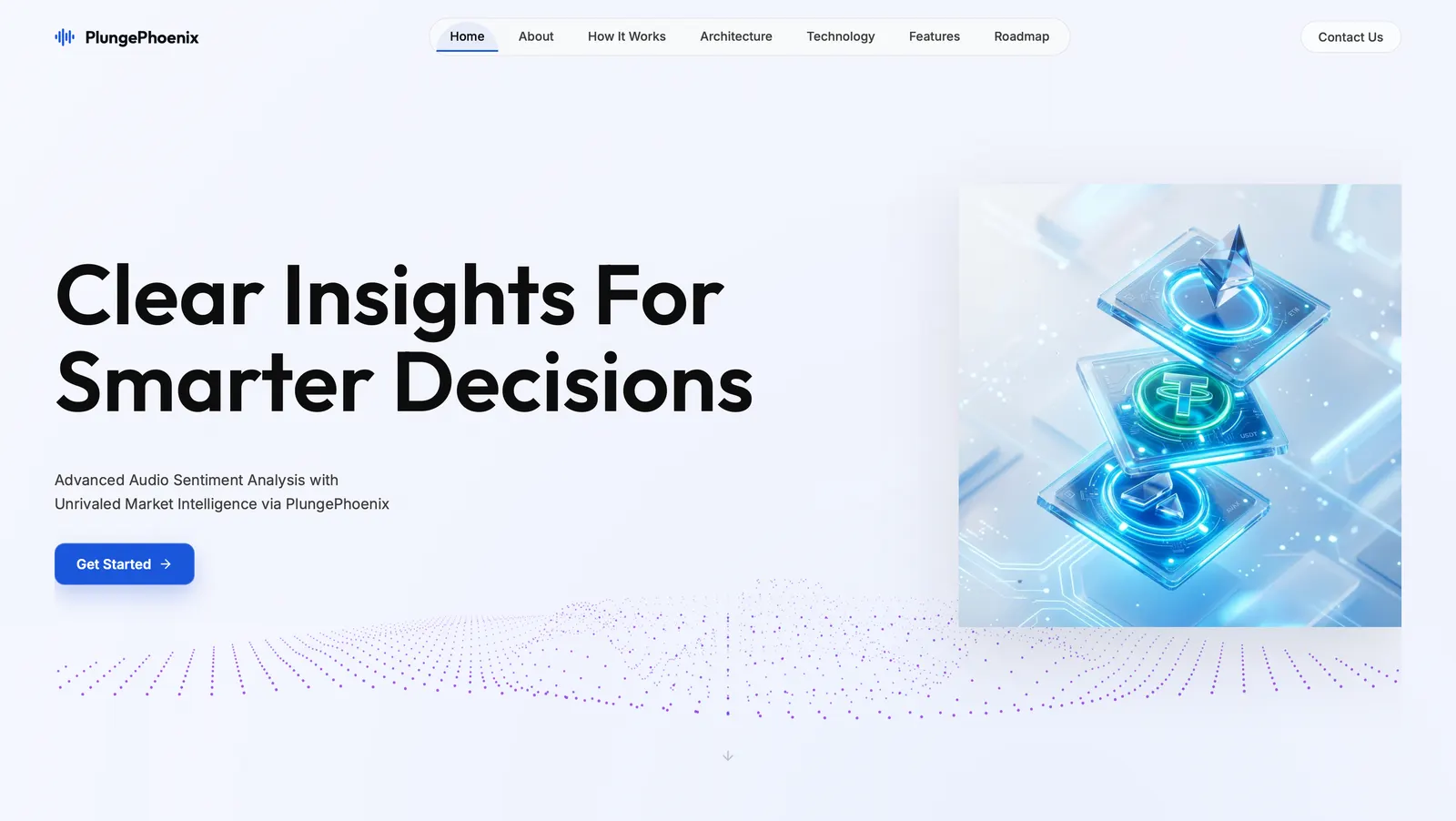
ParticipantTwo hours to build a complete product, frontend and backend. Bhavishya and I built PlungePhoenix, an AI market-intelligence platform that listens to spoken market commentary, scores the panic in it and turns live financial news into trading insight. We didn't finish on the clock. I finished it afterwards. 🔥
- When
- May 2026
- Where
- Chitkara University, Punjab
- Hosted by
- Code 2 Chill Club · Chitkara University
- Format
- in person · 2 hours
[01]The squad
- Govind Jindal← that's me
- Bhavishya Grover
My role · Backend & AI pipeline
[02]The rounds
Round 1
The brief
Build the whole thing, frontend and backend, in two hours. No mock-ups, no slides: a working product.
Round 2
The two hours
I took the backend: FastAPI, speech-to-text, the panic scorer and the RAG pipeline, with the audio input fixed at 17:23. The frontend landed in plain HTML, CSS and JS at 17:53, when I'd planned for React, and the time went into stitching the two together. The clock won.
Not finished on time ⏱️
Round 3
After the bell
In July I came back and finished it properly: a React 19 frontend, API retries, structured errors, a Gemini fallback for the LLM and a full SaaS landing page, deployed on Vercel.
Shipped 🚀
[03]What we built
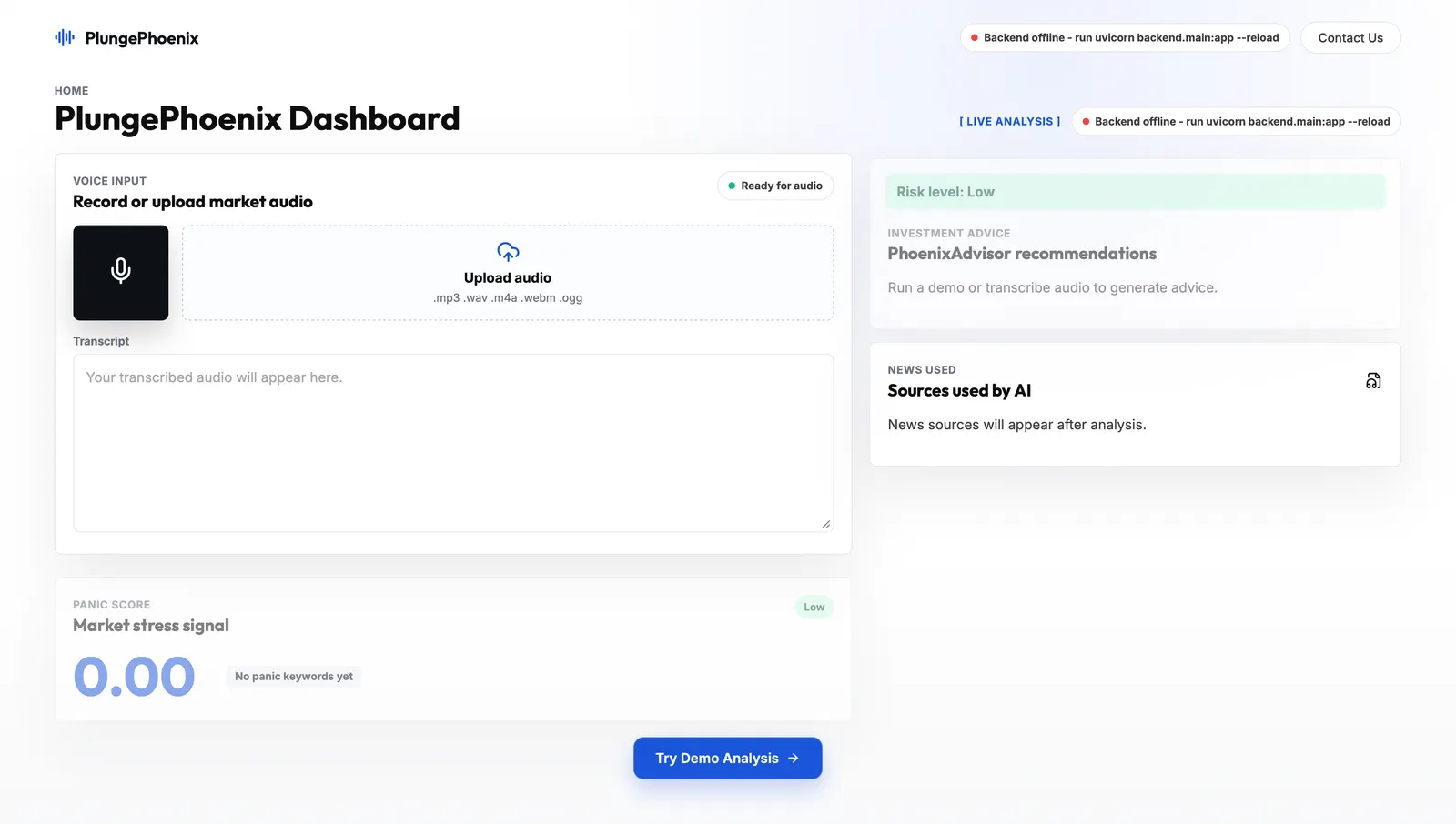
PlungePhoenix
Running live, right here. Click around.
Audio sentiment analysis
Record or upload market commentary. AssemblyAI transcribes it, with exponential-backoff retries, and the transcript drives everything after.
A panic score
A weighted keyword engine ("crash" counts for 1.0, "volatile" for 0.5) scores market stress from 0 to 1 and classifies it from low to extreme, streamed live over a WebSocket.
RAG over live news
Financial news from RSS feeds is cleaned, embedded and stored in ChromaDB. The transcript pulls back the ten most relevant articles as context.
AI recommendations
Transcript, articles and panic score go to an LLM that returns structured buy, sell or hold signals with confidence and the sectors affected.
An LLM that doesn't go down
OpenRouter first, Gemini as the fallback, with retries and automatic re-prompting when the model returns malformed JSON.
[04]Plot twist
The stack decision
Then 😱
Split the work and start typing: I'd do the backend, my partner the frontend. I wanted React; the frontend came back in HTML, CSS and JS, and two hours don't leave room to rebuild or to glue mismatched pieces.
Now 🧠
Agree on the stack before the clock starts, in the first five minutes, out loud. The mistake cost us the finish, and taught me more than a finish would have.
[05]The two hours, in commits
$ git log --reverse --since="2026-05-18" --until="2026-05-19" --format="%h %ad %s"
- 1ec3df716:55Completed Initial Backend Phase
- 3943e1416:55Added Run File
- fad501016:58Added gitignore
- 8ca360317:23Fixed Audio Input
- f577a0117:53Completed Initial Frontend Phase
- eb6341717:57Merge pull request #1 from glitchybhavi/main
$
- Commits
- 6
- Span
- 62 min
- Avg. message
- 25.5 chars
- Shortest
- “Added Run File”
Times in IST, from the repo. The rest of the history, from 25 July, is the version you can open today.
[06]From the floor
[07]The certificate
 Delivered ✓
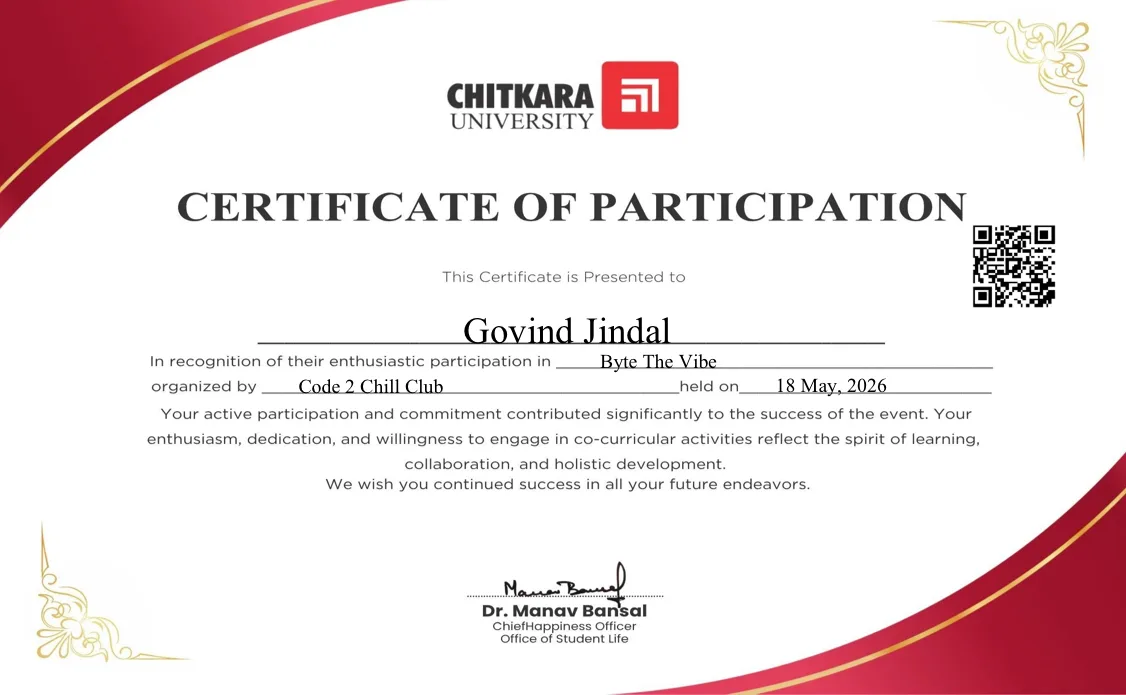
Certificate found. 📬
For participating in Byte The Vibe, organised by the Code 2 Chill Club on 18 May 2026. Signed by Dr. Manav Bansal, Chief Happiness Officer, Office of Student Life. 📜
“Once again the clock won, and the lesson was clear: the code wasn't the bottleneck, the coordination was. Pick the stack together, then build. And finish the thing anyway. 🔥”
Next hackathon
Finvasia Innovation Hackathon 2026