[05]hackathon
★ My first mobile appHackSecure '26
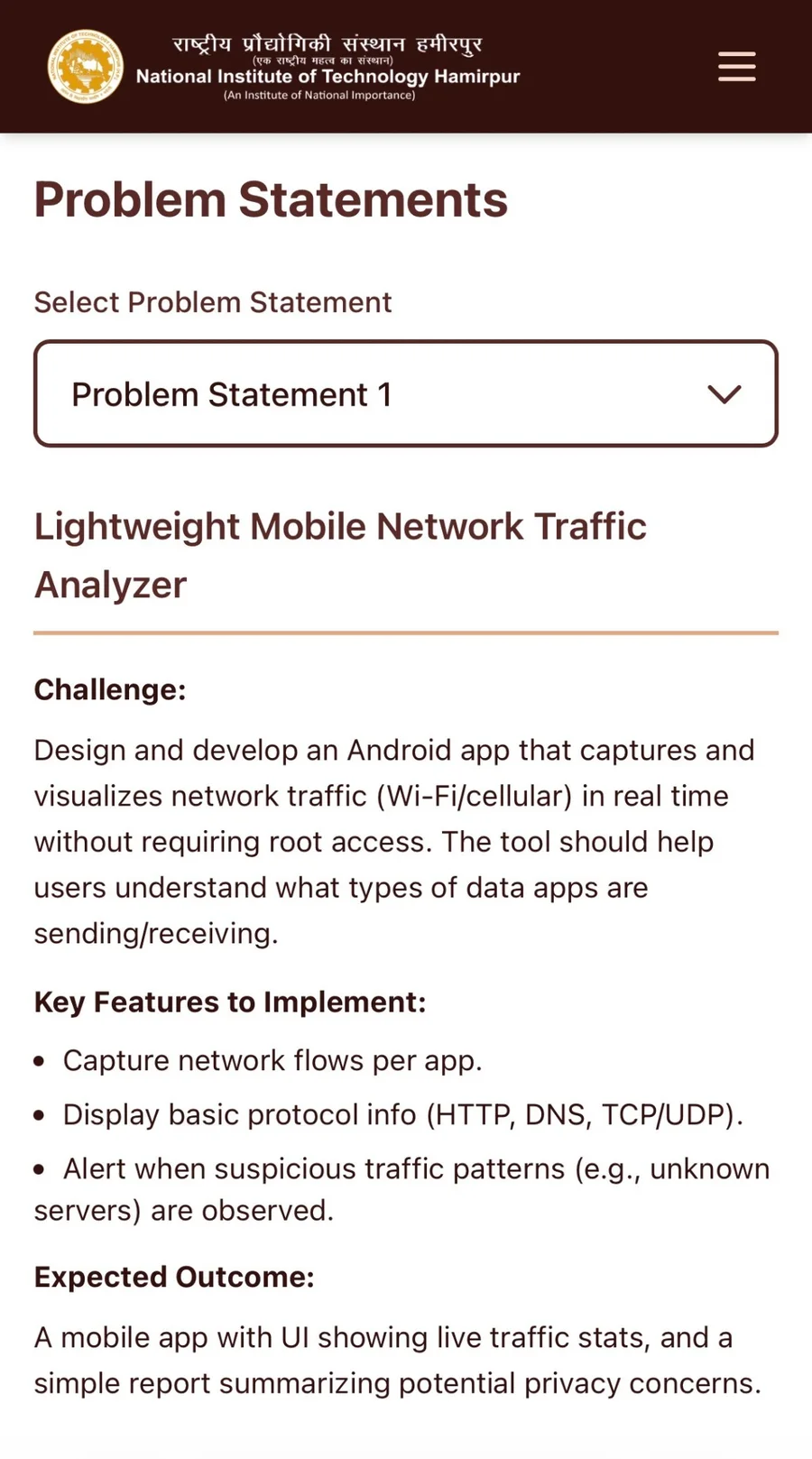
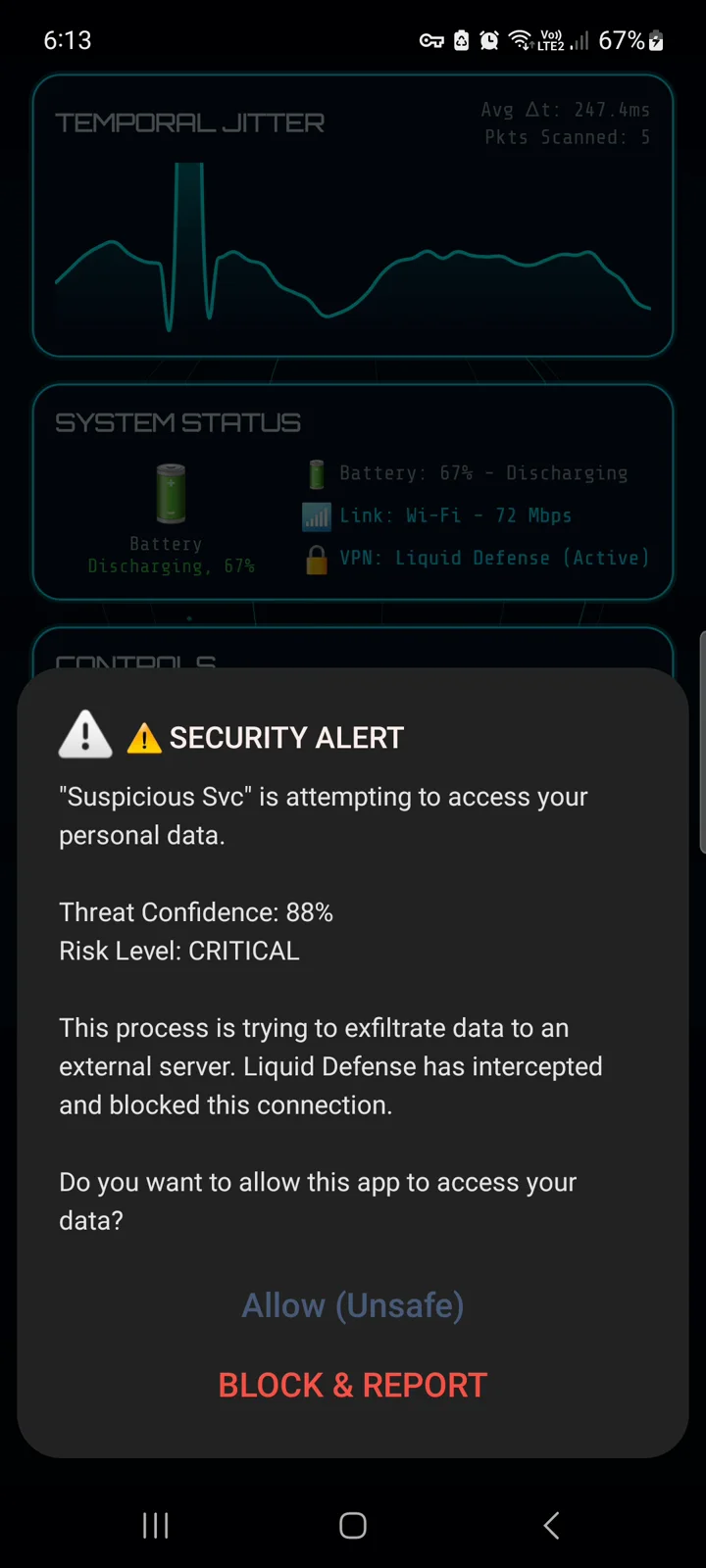
🫠 Not selectedThe problem: an Android app that captures and explains network traffic per app, with no root access. Our answer was Liquid Defense, an on-device firewall where a continuous-time "liquid" neural network watches the rhythm between packets and a C++ tap reads them straight off the VPN. It was my first mobile app. We didn't make it past the online round, and the trip to NIT Hamirpur stayed a daydream.
- When
- February 2026
- Where
- Online round · NIT Hamirpur, Himachal Pradesh
- Hosted by
- NIT Hamirpur
- Format
- online · Online submission round
- Track
- Lightweight mobile network traffic analyser
[01]The squad
- Govind Jindal← that's me
- Piyush Sharma
- Manan Kochhar
- Bhavishya Grover
[02]The round
Round 1
Online submission
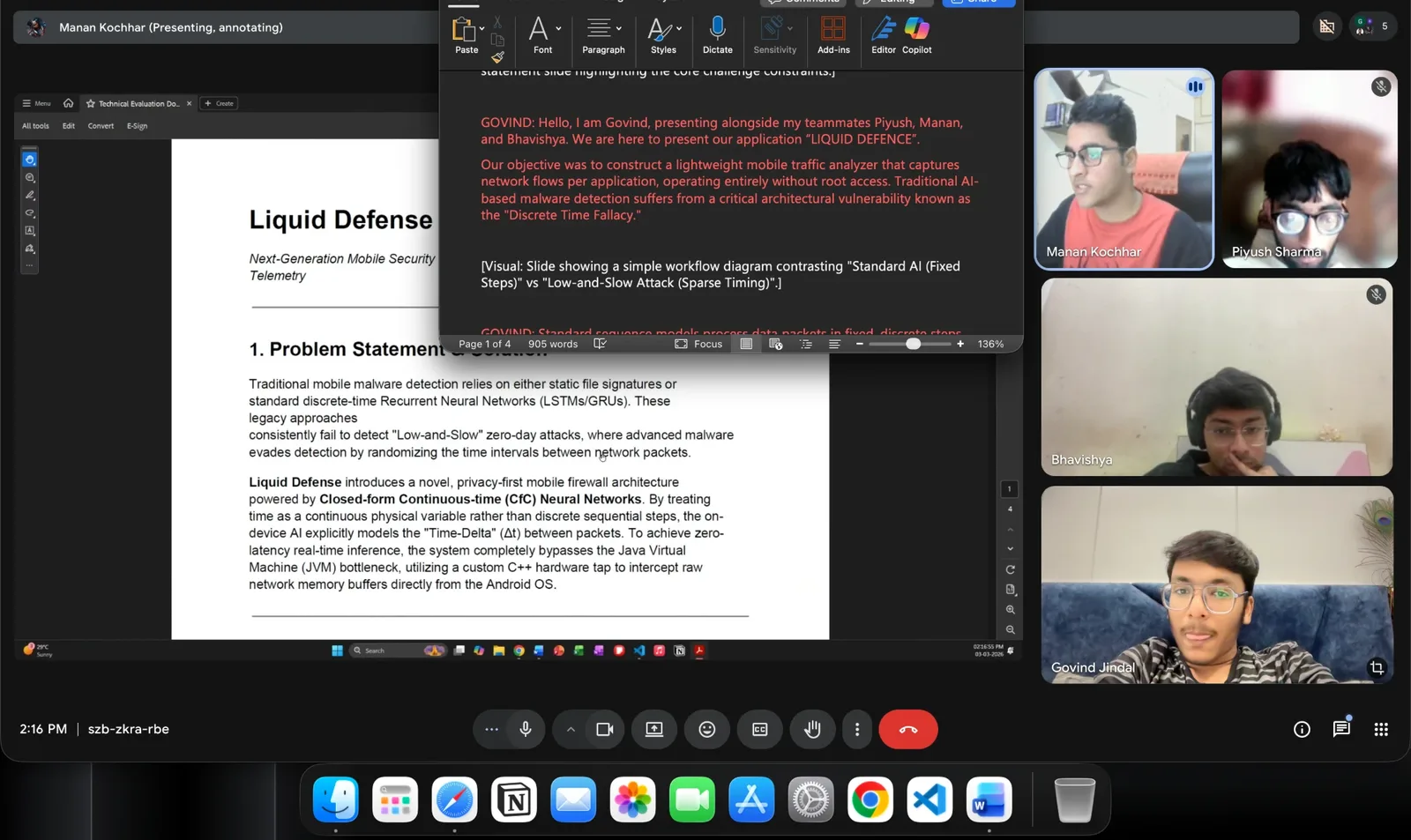
The app, a project video, a technical evaluation document and a résumé for every member, built and sent from four different homes over Google Meet.
🫠 Not selected
[03]What we built
Liquid Defense
Continuous-time AI
A Closed-form Continuous-time (CfC) network takes the time between packets as an input. Malware that beacons, sleeps ten minutes and beacons again can't hide in the gaps.
Native C++ packet tap
Raw packets are read straight from the VPN file descriptor in C++ over JNI, which keeps the garbage collector off the hot path.
On-device ONNX inference
A rolling 50-packet window of size, protocol, direction and Δt, scored every 10 packets as P(safe) against P(malware). Nothing leaves the phone.
No root needed
Android's VpnService routes traffic through a local TUN interface, and every flow is traced back to the app that sent it.
Split tunnelling
Trusted heavy apps like YouTube and Chrome skip the engine, so 4K keeps playing while background traffic gets scored.
Live threat alerts
A threat score, a temporal-jitter graph and a raw console. Hit "Simulate attack" and an alarm rings until you choose to block or allow.
[04]The film 🎬
[05]Side quests
Four résumés, one hour
The submission needed a résumé from every member. With an hour left on the clock, I wrote all four. 🏃♂️💨
4 CVs · 60 minHello, Android
I'd never built a mobile app. So for my first one we went straight for C++ over JNI, a VPN service and a liquid neural network. 🙃
First app ✓The 11:30 PM stand-up
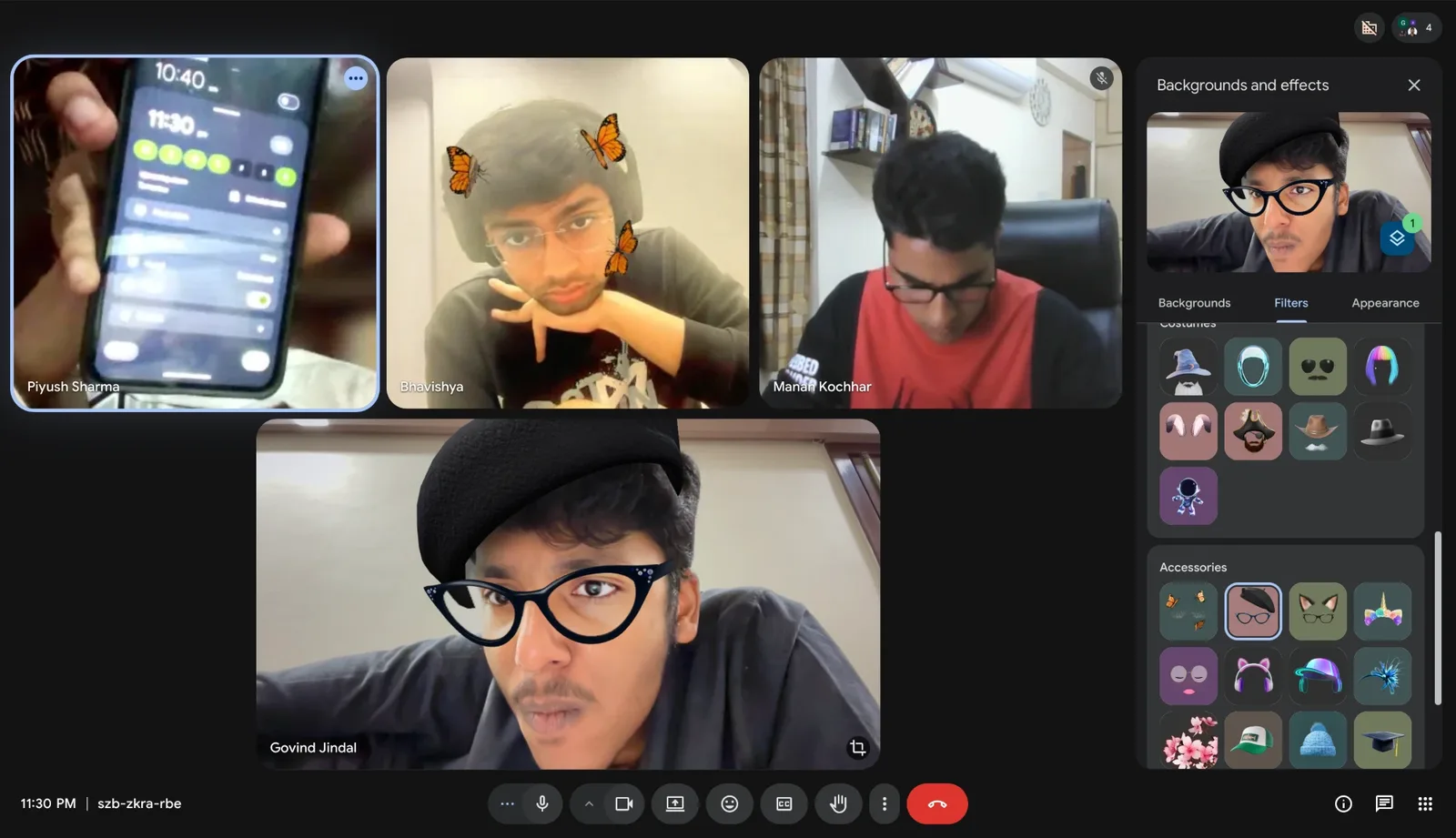
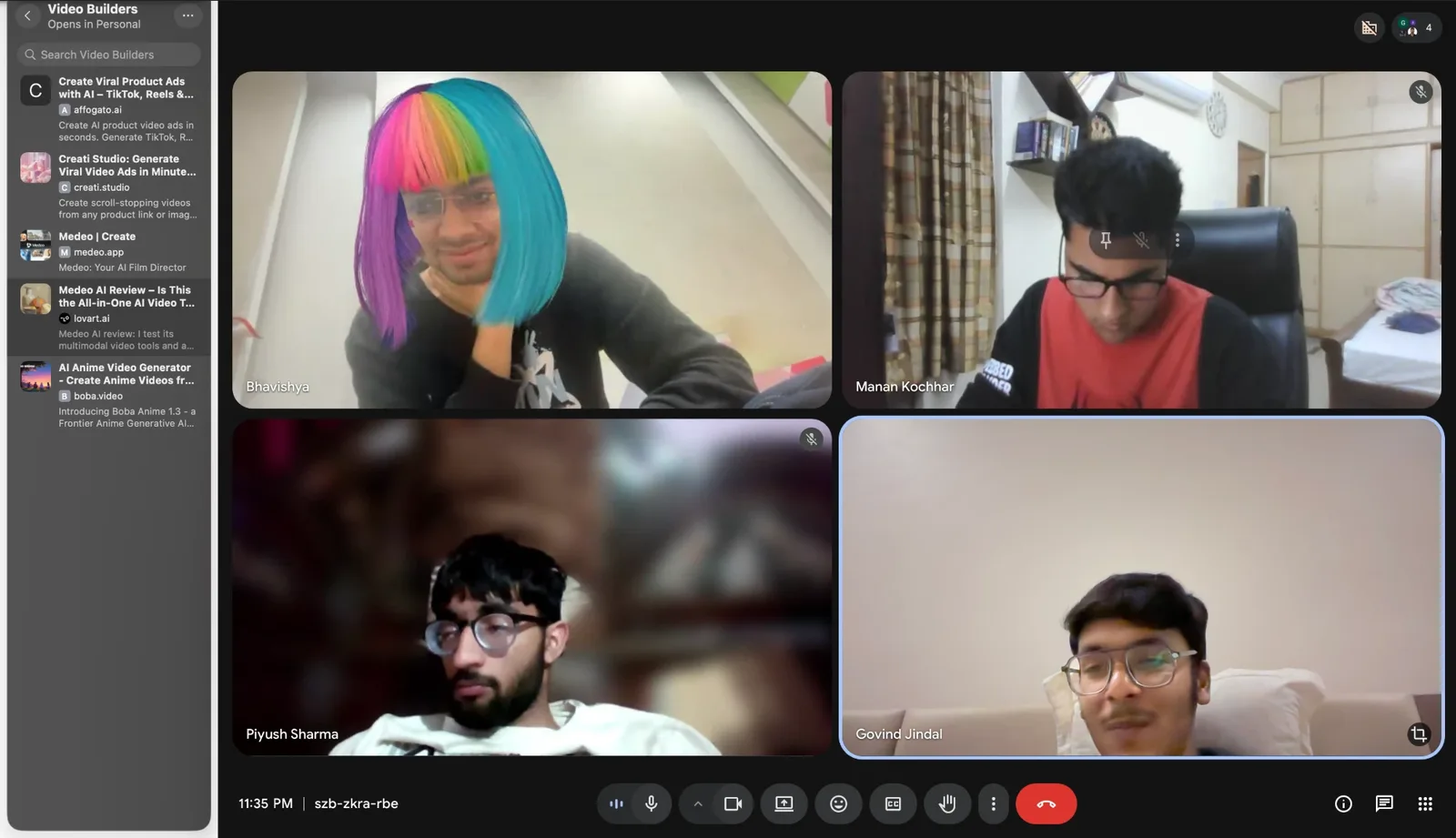
Everyone at home, everyone on Google Meet, every filter switched on. A beret and cat-eye glasses count as a dress code. 😎
Filters onA guide for a five-year-old
There's a real commit in the app repo called "Add simple guide for 5yo". The guide is in there too.
ELI5 ✓NIT Hamirpur, almost
We had the trip to the hills half planned in our heads. Then the online-round results came out. 🏔️
Trip cancelled
[06]From the floor

“My first mobile app, and we skipped the to-do list and went straight for raw packets and continuous-time neural networks. We didn't make it to Hamirpur, but I came out knowing how Android actually moves data, and that a résumé can be written in fifteen minutes if it has to be.”
Next hackathon
AI for Sustainability Hackathon 2026