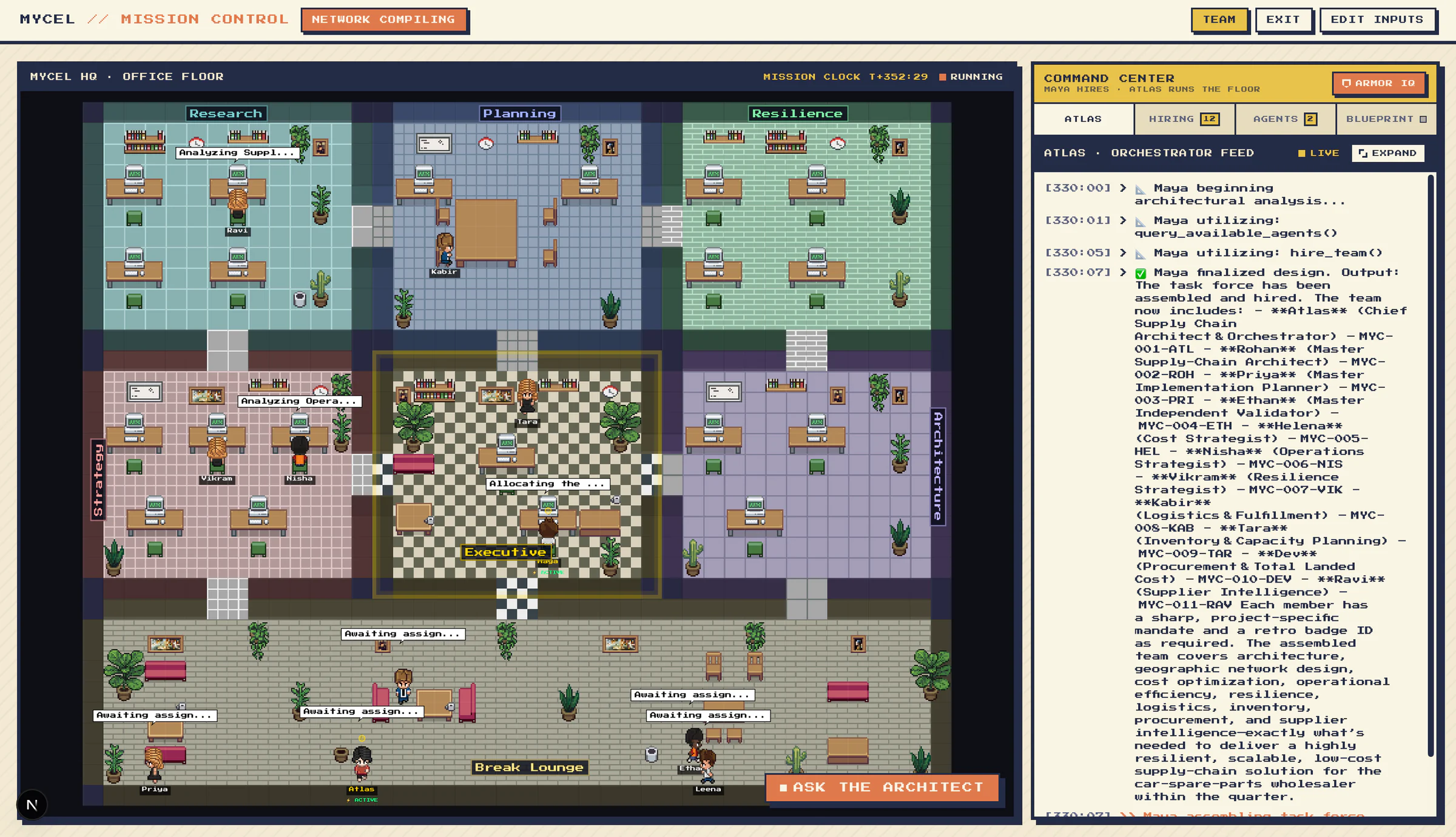
Traditional supply-chain software asks you to already know your supply chain. MYCEL inverts that. You describe a business — “I’m a car spare-parts wholesaler serving a 150 km radius around Hisar” — and an entire AI organization wakes up, hires itself, researches the real world, argues internally about the trade-offs, tries to break its own design, and hands back a fully specified network: every node, edge, cost, lead time, risk score and fallback path, documented.
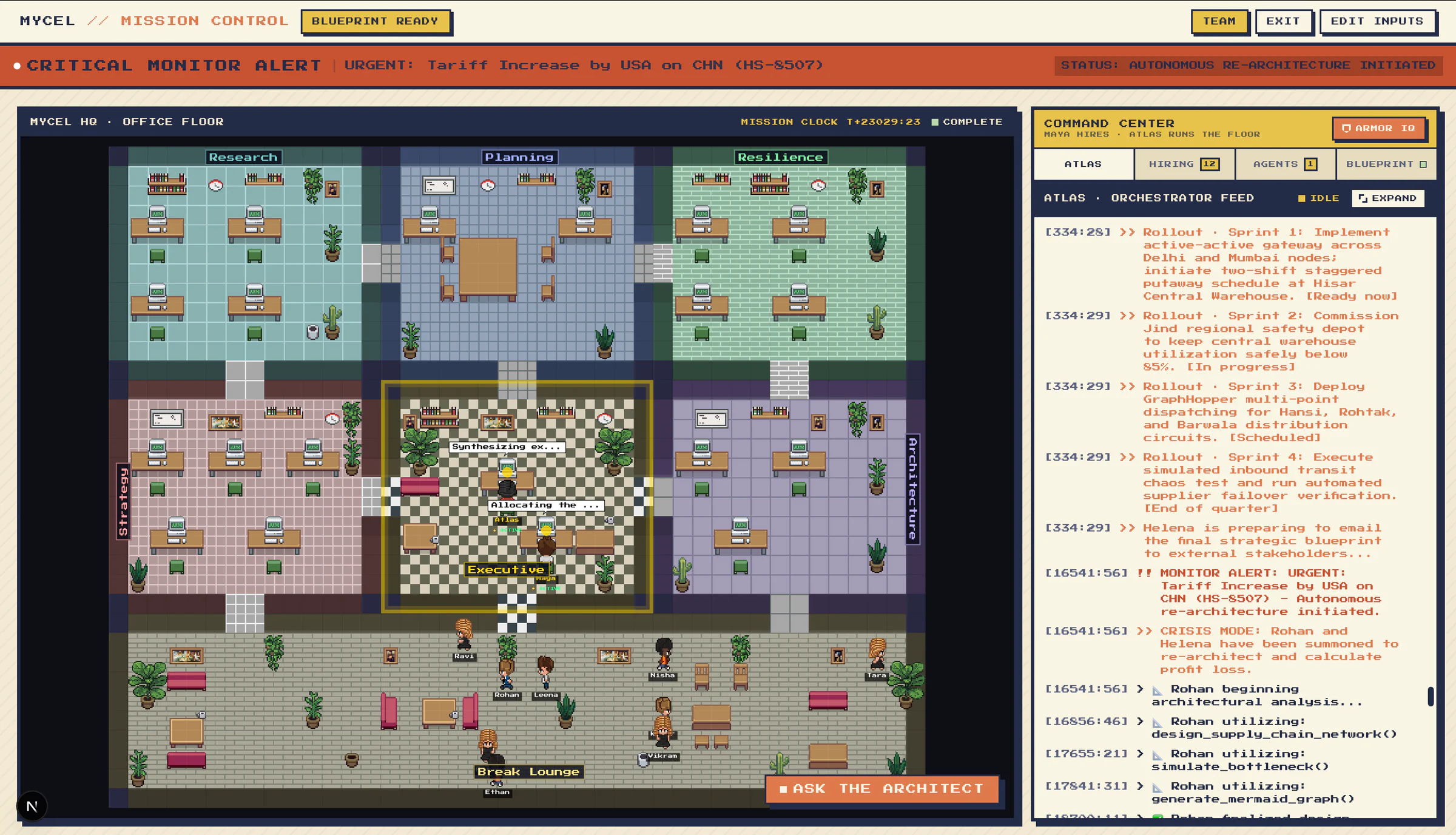
Then it keeps watching. When a tariff changes, a cyclone nears a warehouse corridor or a supplier’s country destabilises, the organization reconvenes and re-architects the network on its own — like the mycelium it is named after, a living network that routes around damage.
We built MYCEL as Team Evolve AI for SAP HackFest’26, from 200+ teams in Round 1 to the Top 10 at the Grand Finale at Chandigarh University. My teammates led the backend and agent orchestration; I worked on the frontend and integrations, making sure every piece connected and worked together.
Three ideas behind it
- It hires, not just runs. A hiring agent reads the brief and assembles the minimum viable task force. A 22-agent organization runs as a four-agent team when that’s all the problem needs, and agents left on standby never spend a token.
- It disagrees with itself. Four adversarial strategists debate over four rounds — cost against resilience, operations against wishful thinking, compliance hunting blind spots — and the chair records each decision with its trade-off.
- It never fabricates. Every claim is tagged verified, estimated or unknown, and an independent validator attacks the blueprint before sign-off, with the power to fail it back to the council.
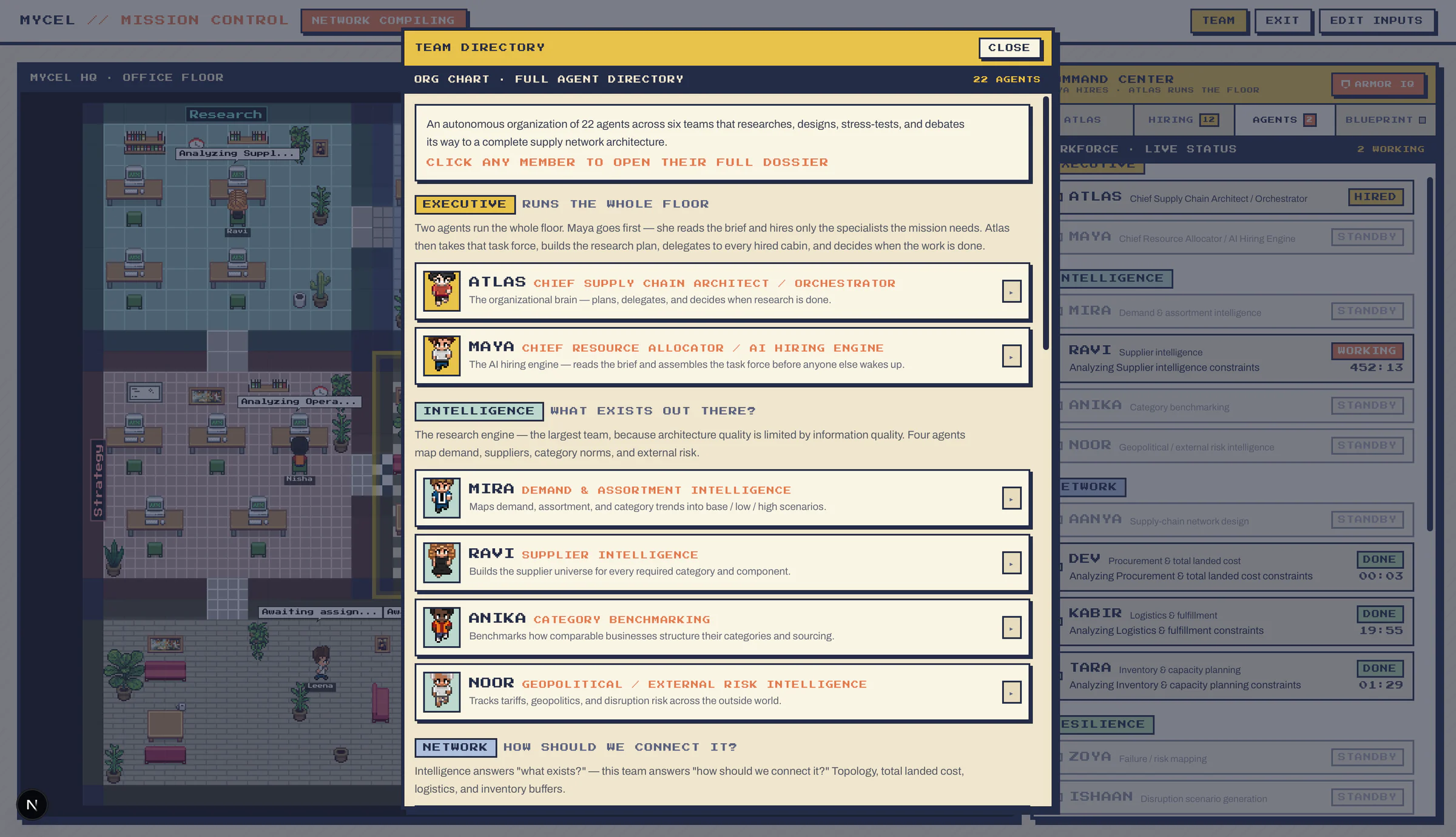
The workforce: 22 agents, 6 teams
- Executive — Maya, the hiring engine, and Atlas, the chief architect who plans the research, delegates to every hired cabin and decides when the work is done.
- Intelligence — demand and assortment, supplier discovery (built per component, not per product), category benchmarking and geopolitical risk.
- Network — network design and centre-of-gravity siting, landed cost, logistics and fulfilment, inventory and capacity.
- Resilience — failure mapping (FMEA), disruption scenarios and Monte Carlo simulation, stress testing to the breaking point, continuity and recovery plans.
- Council — cost, resilience and operations strategists, a risk and compliance officer screening for sanctions, and a chair who weighs the debate against the user’s ranked priorities.
- Architecture — the master architect, an implementation planner who sequences the rollout, and the independent validator who runs chaos simulations against the final design.
Each agent is a self-contained module — identity, system prompt, tool surface and executor — so adding a specialist means adding one module, with no change to the orchestrator.
A four-phase pipeline
- Hiring — the brief, compiled from the wizard into a natural-language mission, goes to Maya, who reads the live agent registry and hires only the load-bearing skills, each with a one-line mandate.
- Research & discovery — intelligence, network and council agents run in parallel, and their findings are condensed into a shared context that carries forward without overflowing the model’s window.
- Drafting, then red-teaming — the architects draft the optimal network; the resilience cell and validator then attack it to find single points of failure.
- Synthesis — Atlas compiles everything into a strict, structured blueprint. Output is validated and normalised before it reaches the interface, with an automatic repair pass if the structure is malformed — so the map never breaks on a bad generation.
The monitor: autonomous crisis response
The blueprint doesn’t get filed away — it is compiled into a monitoring profile of the network’s entities, locations, commodities and routes, each scored for how critical it is. A separate service watches nine real-world sources: global news, disaster alerts, earthquakes, weather at watched coordinates, tariff changes, trade measures and supplier page changes, each polled on its own schedule with independent health so one failing feed never blocks the rest.
Every event passes through a pipeline built to keep noise out:
- Near-duplicate detection collapses the same story reported many times.
- Fuzzy entity and geographic matching ties an event to the network.
- A hard relevance gate — an event must match on entity, location, commodity, route or country before it costs a single AI call.
- Deterministic correlation groups related events into situations, with language-model analysis only for the ambiguous survivors.
- Severity scoring weighs how dependent the network is on what’s affected and how much alternate coverage exists, then escalates with cooldowns and rate limits.
When a critical alert lands, a crisis team is summoned to re-architect the network around it and estimate the profit impact. Delivery is idempotent, so a retried alert never triggers a second re-architecture. Every past crisis is carried forward as a standing constraint, so the network never regresses into a risk it has already routed around.
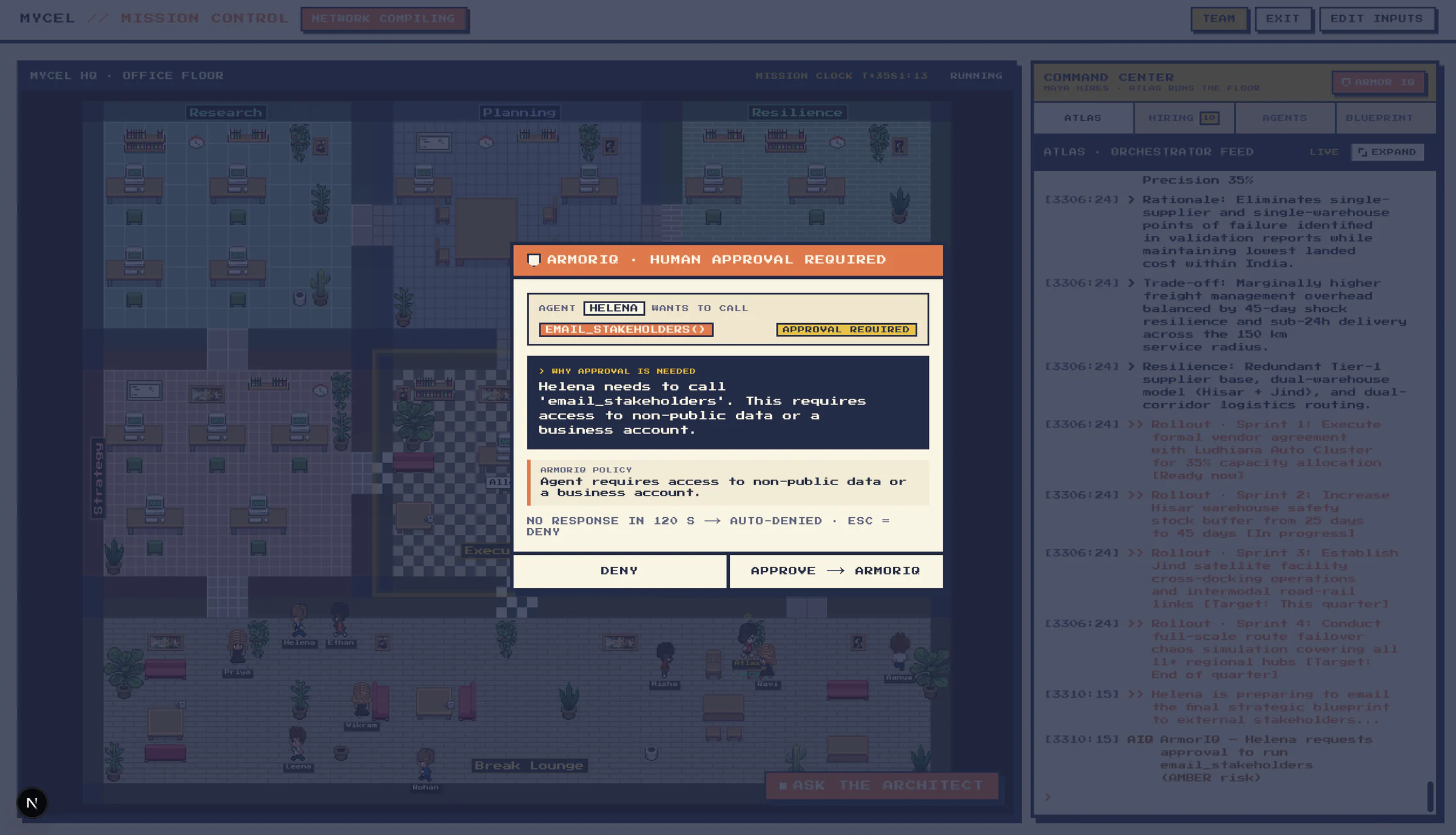
Human in the loop: ArmorIQ
Autonomous doesn’t mean unsupervised. Every tool call an agent wants to make is classified before it runs:
- Green — research, calculations and simulations execute on their own and are logged.
- Amber — contacting suppliers, emailing stakeholders or touching business data pauses the agent and asks a human in the interface. No answer in two minutes means auto-deny.
- Red — purchases, signing agreements, committing funds or writing to records are blocked outright.
Unknown tools default to amber, so nothing new is ever silently autonomous. Behind the gate, high-risk actions pass intent validation, a least-privilege policy check and risk scoring, with a full audit trail.
The interface
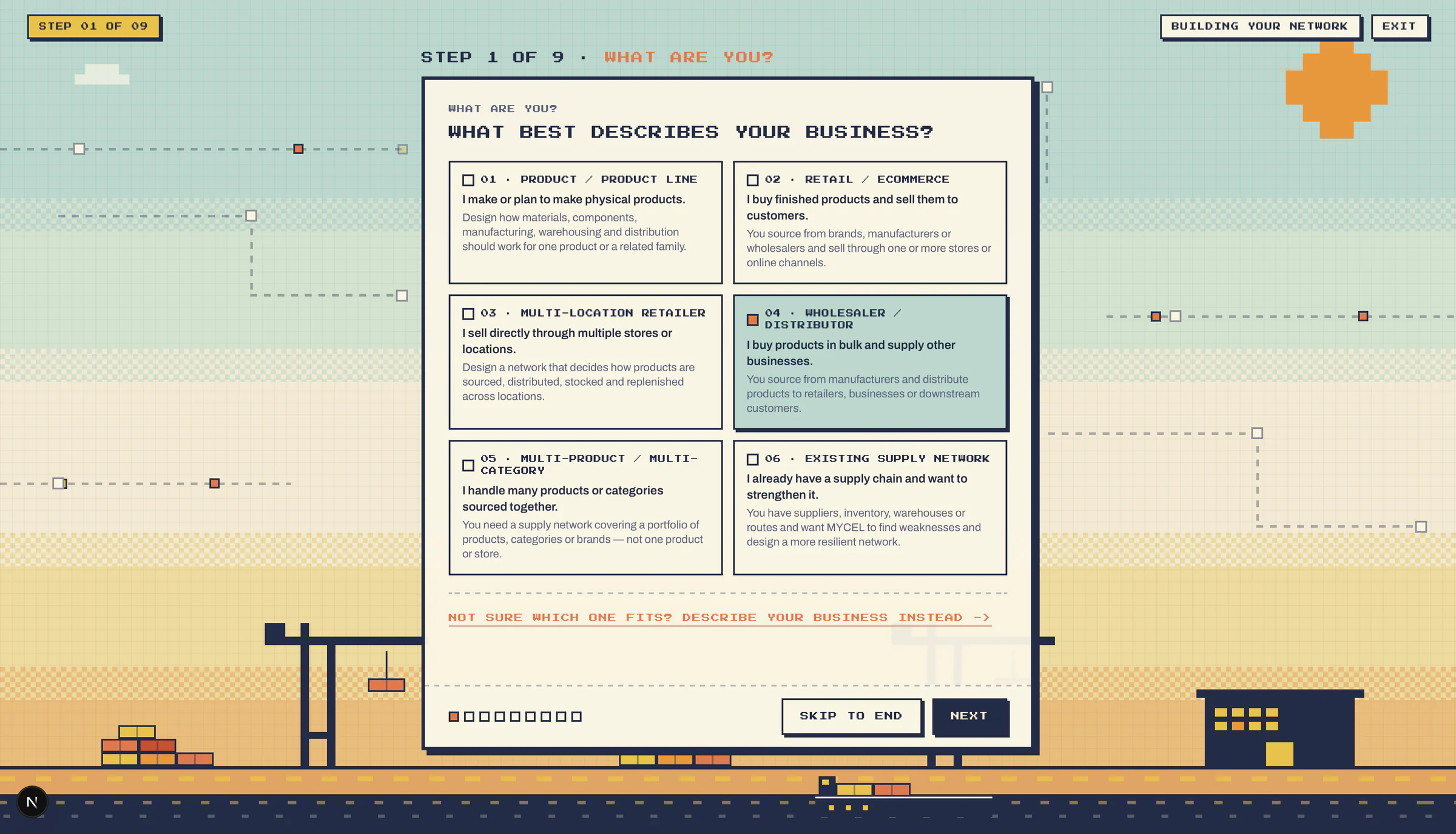
- A nine-step intake wizard built on progressive context: three questions to start, then optional depth — volumes, deadlines, cost pressure, a drag-to-rank priority stack and real documents.
- Document grounding — uploaded PDFs, spreadsheets and contracts are parsed, chunked, embedded and indexed in a vector store, so agents reason over the business’s own data.
- Mission Control — a 60 fps canvas office with a custom tile-map and sprite engine. Every hired agent is a sprite with pathfinding and live speech bubbles, driven by real events streamed over WebSockets.
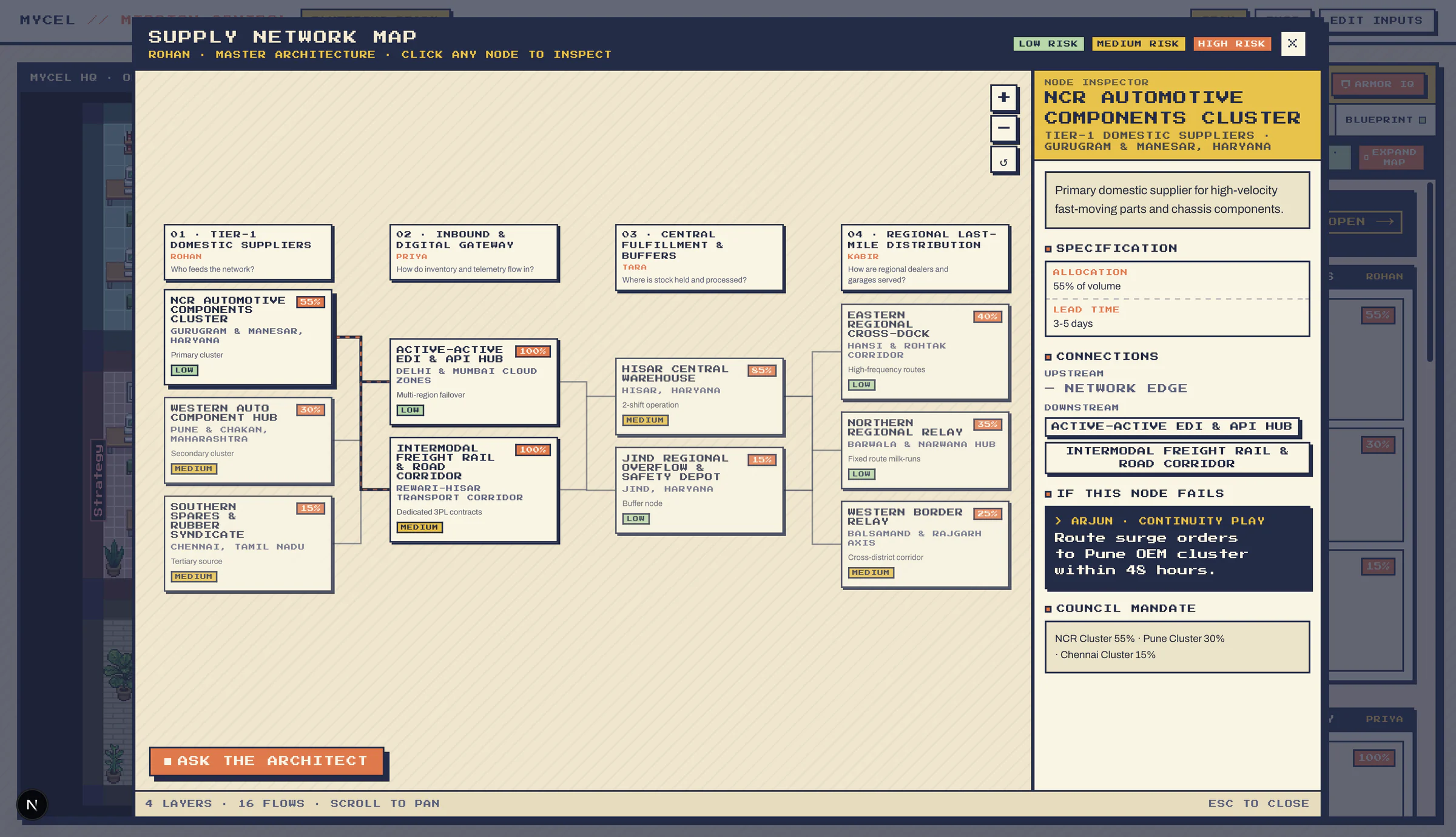
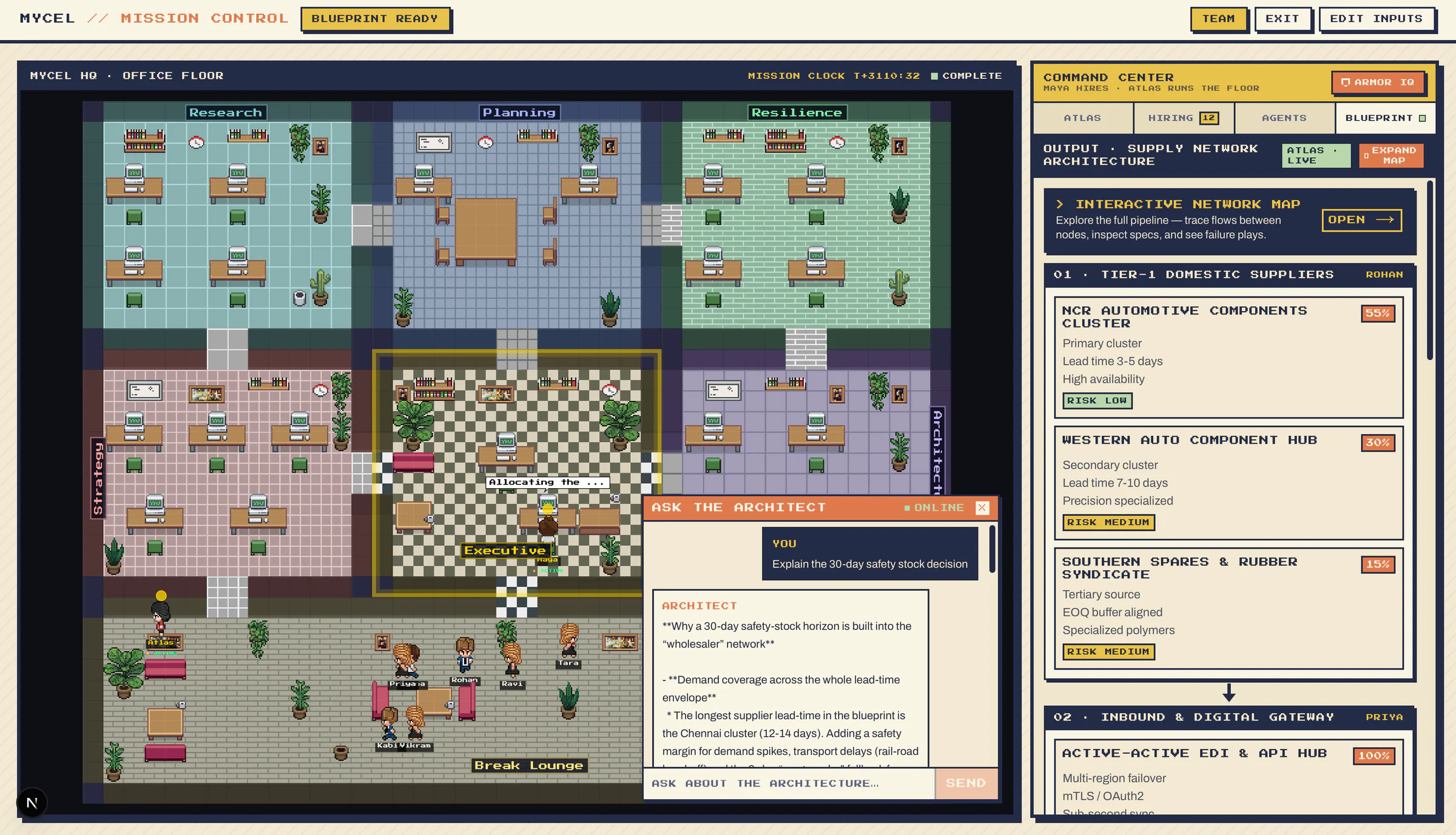
- An interactive network map — pan and zoom across sourcing, hubs and distribution, and inspect any node for its allocation, lead time, risk band, failure play and the council mandate that put it there.
- Ask the Architect — a streaming chat that answers why from the blueprint’s reasoning trace and the vector store.
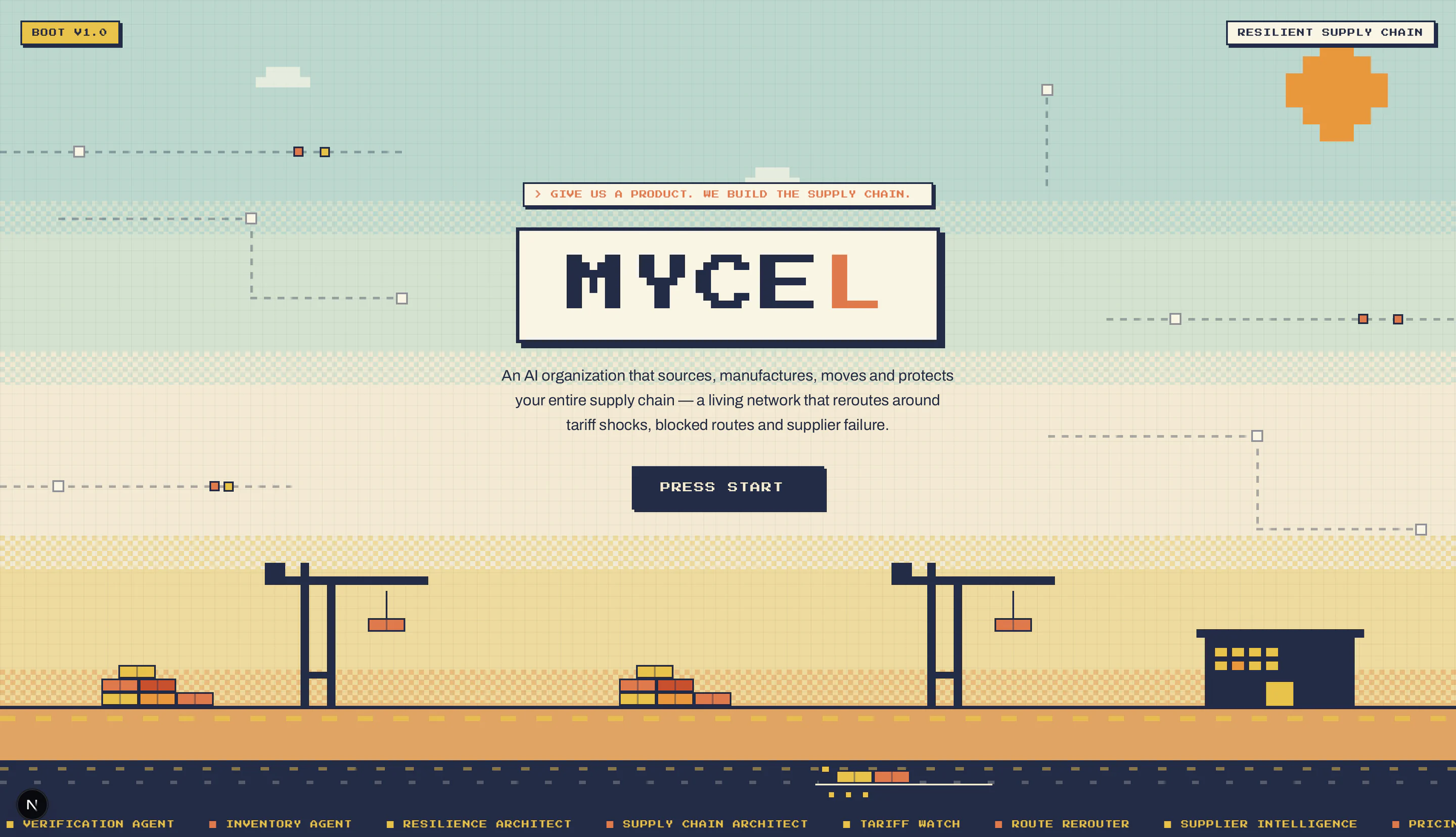
- A deliberate retro-terminal design system — paper cream, navy ink and terracotta, hard edges and a pixel display face — because a supply chain is infrastructure, and MYCEL presents itself as an operations console, not a dashboard.
Under the hood
- Frontend — Next.js and React 19 with TypeScript, Tailwind CSS v4, a custom 2D canvas engine and the Vercel AI SDK for streaming chat.
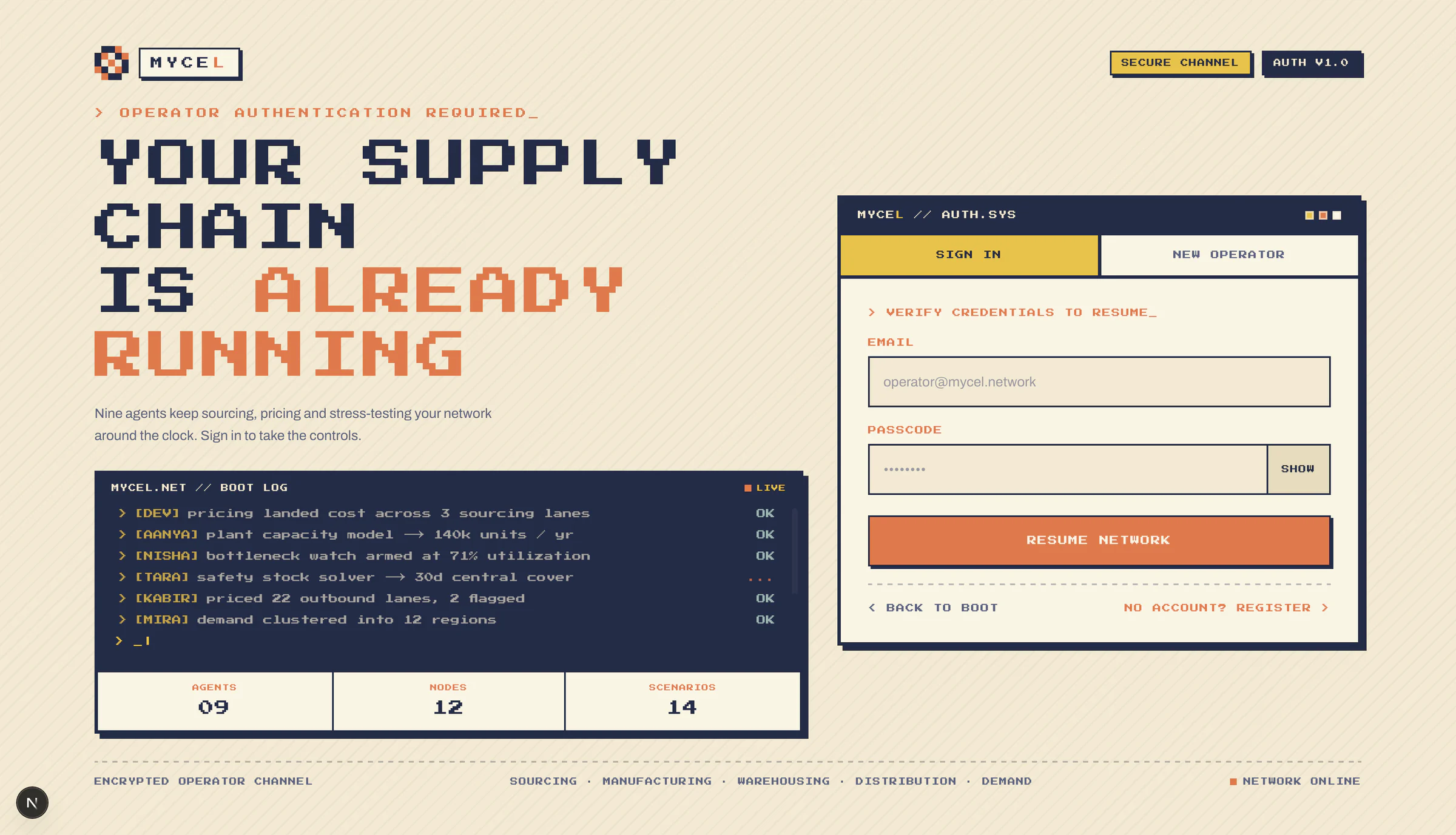
- Backend — async-first FastAPI with typed contracts end to end, JWT authentication and native WebSockets for the live event stream.
- Models — fast open-weight models served on Groq for the parallel agents, with automatic failover so a task is never dropped mid-flight, and Gemini for the large structured synthesis.
- Data — MongoDB for projects, sessions, logs and crisis history; RabbitMQ as a durable task queue that survives restarts; FAISS for retrieval; SQLite for monitor state.
- Research & analysis — live web search and extraction, plus quantitative tools for centre of gravity, EOQ, FMEA risk priority, Monte Carlo and FX.
- Infrastructure — three independently deployable services (interface, backend, monitor) on a shared data plane, brought up together with Docker Compose and health checks.
Sourcing · manufacturing · warehousing · distribution · demand — one living network.